
How to Find Out What AI Says About Your Business (And What to Do About It)
The internet is moving so fast that I learn something new about this every single day. Which is fun! And also a little bit a lot. I’ve been working on AI discoverability for close to two years, and I’m still clicking around at 11:42pm going “wait, but what about THIS.”
So I wanted to walk you through the actual process of finding out what AI says about you — what I did, what I found, and what you can do about it.
The short version, up top:
- You can ask AI tools directly what they know about your business (and what a fun thing to do!) — and you should.
- The answers vary depending on which tool you use and how you ask.
- The biggest levers are trust signals (so things like reviews, mentions, anything that comes from a person that’s not you basically), your website copy and structure (they’re a Big Deal), and your metadata and schema data (this is where we nerd out sooo hard).
- You’re never ever really done… but you can absolutely make meaningful progress, and then mostly leave it alone.
Table of Contents
Why this matters (and who it’s actually for)
First: not everybody needs to care about this equally.
About 27% of consumers now start their searches with AI instead of Google — and that number is climbing every day. If your goal is mostly word-of-mouth and referrals, and you’ve got enough work coming in that way, cool. Go enjoy your weekend.
But if you want your website to do the heavy lifting — if you want to spend less time on social (hey, it’s me!) and more time actually doing your work — then how you show up in AI search matters. A lot.
It’s happening right now, whether you’re paying attention or not. Someone is asking an AI tool “who should I hire for [thing you do]” and getting an answer. The question is whether you’re in it.
This is literally exactly what we do. We build websites that get found. So understanding how AI reads and cites and recommends, that’s the job.
Which AI tool to use for this
Different engines are going to give you different answers. ChatGPT, Claude, Gemini, and Perplexity are all pulling from different sources, trained differently, and weighted differently.
So for your first audit, you want something that’s pulling from the open web, not a tool that already knows you.
I use Perplexity for this specifically because:
- It cites its sources so you can see where it’s pulling from — huge
- It searches the live web instead of just relying on training data
- It doesn’t know me. I’m not logged in, it hasn’t been fed my preferences, and there’s no personalization bias skewing the results
Claude, for what it’s worth, knows my business inside out — and that’s because I’ve spent a stupid (but so, so fun) number of hours setting it up over time. (That’s a whole other post.)
For ongoing work — drafting website copy based on your strategy, thinking through your niche positioning, that kind of thing — we love Uncle Claude around here. But start cold.
Step 1: Search the way your clients search
Don’t just search your business name. That’s a great thing to do later, but it’s not really how your potential clients are looking for you. They’re describing a specific problem or need and hoping that AI spits out a name.
Try something like this.
For a functional medicine / wellness practitioner:
- “best functional medicine doctor for hormone issues in [city]”
- “what’s the difference between functional medicine and integrative medicine”
- “is functional medicine worth it”
Coach or service provider:
- “best business coach for women who want to work less”
- “do I actually need a business coach or can I figure this out myself”
- “what should I look for in a brand strategist”
These are the searches your people are doing. Your name should be appearing in some version of these — or at least, your website should be the thing that AI is pulling from when it answers.
Step 2: Ask what AI knows about you directly
Once you’ve done that: go ahead and ask: “What do you know about [your business name]?”
It’s a great and fun (sometimes humbling) question to ask. A little overwhelming, sometimes. But helpful.
Here’s what Perplexity said about Knap Creative when I asked a while back:
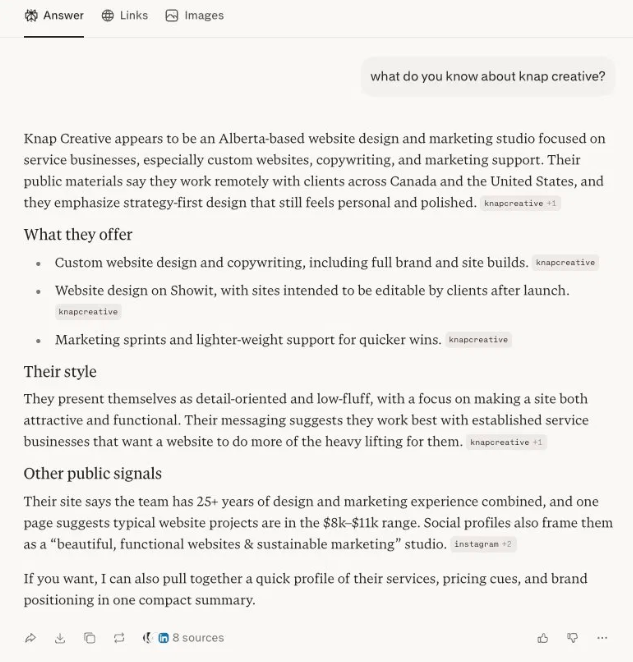
It’s pretty accurate!
A few things missing (our newest offer, Found & Human, isn’t in there yet — because those pages are new and haven’t been fully indexed), and it cited 25 years of experience combined, which is actually just mine — Kenzie has another ten on top of that.
But overall? It knew what we do, where we are, who we work with, and roughly what we charge. That’s a good sign.
The follow-up questions it suggested were also GREAT (and dangerous — I could spend a whole afternoon optimizing for every single one of those rabbit holes, every single week). When an AI tool offers you follow-up questions about your own business, those are basically a map of what it’s curious about and what it thinks searchers might want to know next. That is incredibly useful data.
Step 3: Ask where you can improve
Once you have an answer back on Step 2, do some digging, but also just ask:
“Where could my [business name] improve to show up better in AI search results?”
It’ll give you a punch list. You can ask for follow-up questions on any of the items, go deeper on specific area, and keep going as long as you want. (Infinity, if you’re me.)
The key is to go in with a specific goal so you know when to stop. “I want to understand how I’m showing up for [specific niche] searches is a project. “I want to optimize everything” is a Tuesday that turns into a Thursday, and you’re still not done.
AI won’t suggest this, but do it anyway
After you’ve made any updates to your site, resubmit your pages to Google for indexing.
Super easy, just go to Google Search Console (which is free). It just tells Google, “hey, go check those pages again.” AI tools pull from the indexed web, so if your pages haven’t been recrawled since you updated them, the AI is working with old information. Takes literally five minutes, sometimes less.
What the answers tell you
When you get a result back, you’re looking for a few things:
Is it accurate? Does it know what you actually do, who you serve, roughly what you charge, what makes you different? If it’s vague or wrong, that’s a signal that your website copy isn’t clear enough, or it’s not finding enough external sources to pull from.
Where is it pulling from? Perplexity shows you the sources. Are they your website? Your Instagram? A directory listing? Someone else’s blog post that mentioned you? This tells you where your credibility is actually living on the internet, and it’s such an important layer.
What’s missing? New offers, recent work, a specific niche you want to be known for — if it’s not on the internet in multiple places, it’s not in the answer.
The real levers: what you can actually do
Okay, the good stuff. Here’s what actually moves the needle, roughly in order of impact:
Trust signals.
This is the big one — and honestly, it’s always been true, it’s just more true now. Reviews, testimonials, mentions on other sites (social media counts!), people talking about you. The more proof there is that you’re real and good and have actual clients, the more an AI (and a search engine, and a human) is going to trust what your website says about itself. Getting even two or three Google reviews from the right people can do more than a beautifully structured page. Hard to get sometimes, but there are small steps you can take.
Your website copy and structure.
What your pages actually say, how they’re organized, whether you’ve named your niche clearly, whether you’ve answered the questions your clients are actually asking.
This is where we go deep at Knap — we think about every page as something a real person AND a robot needs to be able to read and understand.
Metadata and schema data
This is the more technical layer — the stuff that lives behind your pages and tells search engines and AI tools what each page is actually about. Schema data especially is something most small business websites don’t have at all, and it’s one of the places where a well-built site can do a lot of work. We go extremely deep on this for our clients. There are levers in there that most people don’t know exist, and by the time we’re done with the site, it’s very, very thorough.
Getting mentioned elsewhere
Guest posts, podcast appearances, being cited in someone else’s article, showing up in a directory that matters for your niche. AI tools are reading the whole web, not just your site. The more places your name shows up in context, the more authority you have.
A note on never being done
I’ll just say it. You’re not. Ever. Done.
AI search visits grew over 40% year-over-year in Q1 2026. INSANE.
You could literally do this every single day and still find new things to look at. The AI tools update, new sources get weighted differently, and you launch a new offer that takes a while to get indexed. It’s onoging.
Start with a goal, do the audit, fix what you can, and then come back occasionally.
You don’t need to live in this. (As fun as it is, honestly.) It’s important to understand it and take the steps that are within your reach, but then let it do its thing.
If this techie stuff is your jam: go nuts. You have everything you need to start today.
If it makes your brain turn into a mashed potato but you care about being found: that’s exactly why we exist. We LOVE this work.
Once every couple of weeks I send an email called “Actually…” It’s a very quick and highly entertaining story from my life (recent topics have included falling out of a golf cart, a strong case for granny panties, and whether AI is making us all sound the same) plus one insight or action step for your website or marketing. You can read it before your coffee gets cold. Sign up here
On which AI tool to actually use for your business work — the full comparison. [→ Claude vs ChatGPT: What I Use, and Why I Made the Switch]
Reviews are the biggest trust signal for AI search. Here’s how to actually get them. [→ Bribery, Reciprocity, and Other Things That Actually Get You Reviews]